
FY 2025-2030 CTP: Tim’s Take
September 6, 2024
Category: Transportation Facts, News / Commentary, Resources,
By Tim Smith, MAA President
Published in the September 6, 2024 Weekly Update
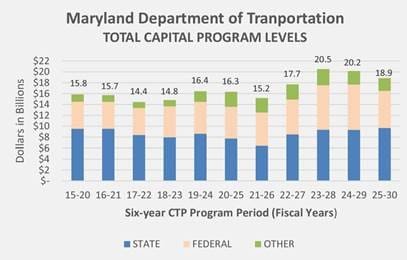
The new FY 2025-2030 Consolidated Transportation Program (CTP) was released this week, and MDOT’s message focuses on a $1.3B “cut” from the previous budget. However, a closer look raises more questions. Let’s start with a summary comparing past CTP budgets to the current one:
While MDOT highlights the $1.3B reduction, my question is: what happened to the $3B+ funding gap we discussed just a few months ago? Especially since we are saying revenue projections are lower than we anticipated so we know we did not get more money unexpectedly. Earlier this year, we were facing a $3.3B shortfall, and although the legislative session made some improvements with vehicle registration and EV-related legislation, those changes amounted to millions, not billions. Even Annapolis admitted these measures were far from sufficient to close the funding gap. And yet, that total of that $3B+ gap seems to have vanished from the conversation and been replaced with a smaller number.
I will also remind all of us the other previous funding deficit still did not include the $600M annual shortfall for system preservation and state of good repair – a “known” gap that Maryland leadership has largely left unaddressed. See links to Asset Management and MDOT Attainment Report (top of page 15) for reference.
Now, let’s examine the $1.3B in deferred projects, which MDOT lists by transportation mode. See Table 1 below for the breakdown:
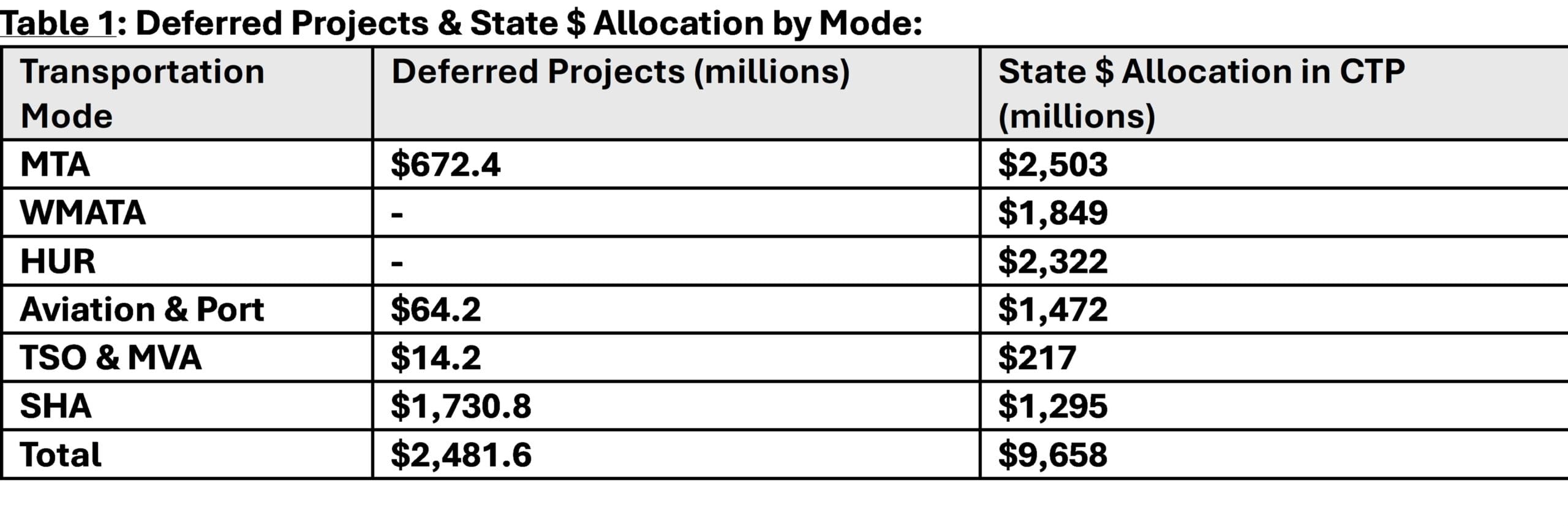
It’s clear that the math doesn’t align with MDOT’s narrative. The deferred projects total nearly $2.5B, not the $1.3B cut being highlighted. Additionally, the bulk of the deferred projects—$1.73B—comes from Maryland State Highway (SHA).
We appreciate the message from MDOT, emphasizing the cuts that occurred across all modes and highlighting the delaying zero-emission electric bus procurement, but they are nowhere close to proportional or appropriate. While the Maryland Transit Administration (MTA) is facing $672M in deferred projects, that’s only about a third of what’s being cut from SHA.
Let’s take a closer look at SHA’s deferred projects:
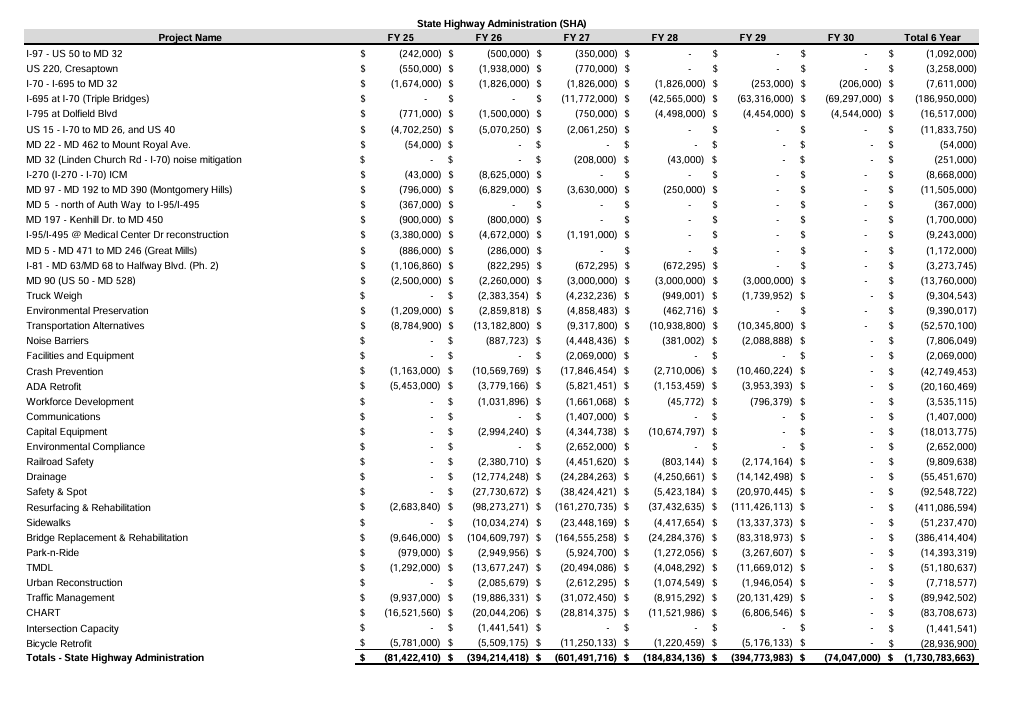
Some alarming trends include $143M deferred from roadway safety (e.g., crash prevention, safety spot improvements, and railway safety), $174M from congestion and incident management (e.g., CHART and traffic management), $153M from active transportation, and $56M from drainage.
From an asset management perspective, the most concerning figures are $411M in deferred resurfacing and rehabilitation projects for the pavement network and $386M in deferred bridge program funding. How can we claim to prioritize safety and system maintenance when these are the very projects being delayed?
For example, our Fund 77 program is ideally funded at around $400M annually to maintain a state of good repair but has averaged about $275M per year in recent years due to budget constraints. In FY 2027, funding for the pavement network is projected to drop to just $61M—an alarmingly low figure for such a critical transportation asset. About 10 years ago, that dollar amount was the paving budget for Prince George’s and Montgomery County alone in SHA.
Meanwhile, WMATA’s share of state dollars has not been cut; in fact, it has increased. Additionally, there are growing commitments to rail transit in Maryland. For context, less than 5% of Maryland commuters use public transit, and even then, most use buses, which operate on roadways already suffering from budget cuts. While we support transit to alleviate congestion and reduce carbon emissions, these efforts need to be grounded in fiscal reality and the current conditions we’re facing.
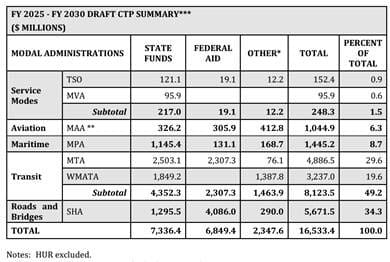
Look again at Table 1. It shows the distribution of state dollars across transportation modes. If you recall our series on federal funding, you’ll understand that the issue lies with state dollars, not federal funding. Most other states are surpassing Maryland in transportation efficiency and performance because their state funding models are more balanced.
Spending nearly 50% of our limited state dollars on 5% of the commuters (even 10% if transit ridership doubles) is fiscally unsustainable. We are neglecting basic needs—like maintaining our infrastructure—to expand rail lines instead of bus lines that would fall within our existing transportation footprint. This allocation of funds doesn’t reflect the reality of what our state needs to function effectively. It’s an aspirational goal with no existing means of funding long term and the short-term solutions cripple every other transportation mode in the process.
We must prioritize maintaining our assets and making strategic investments that serve all Maryland residents. Ignoring these critical issues will only worsen the problems we face in the future.